To Catch a Dictator by Reed Brody
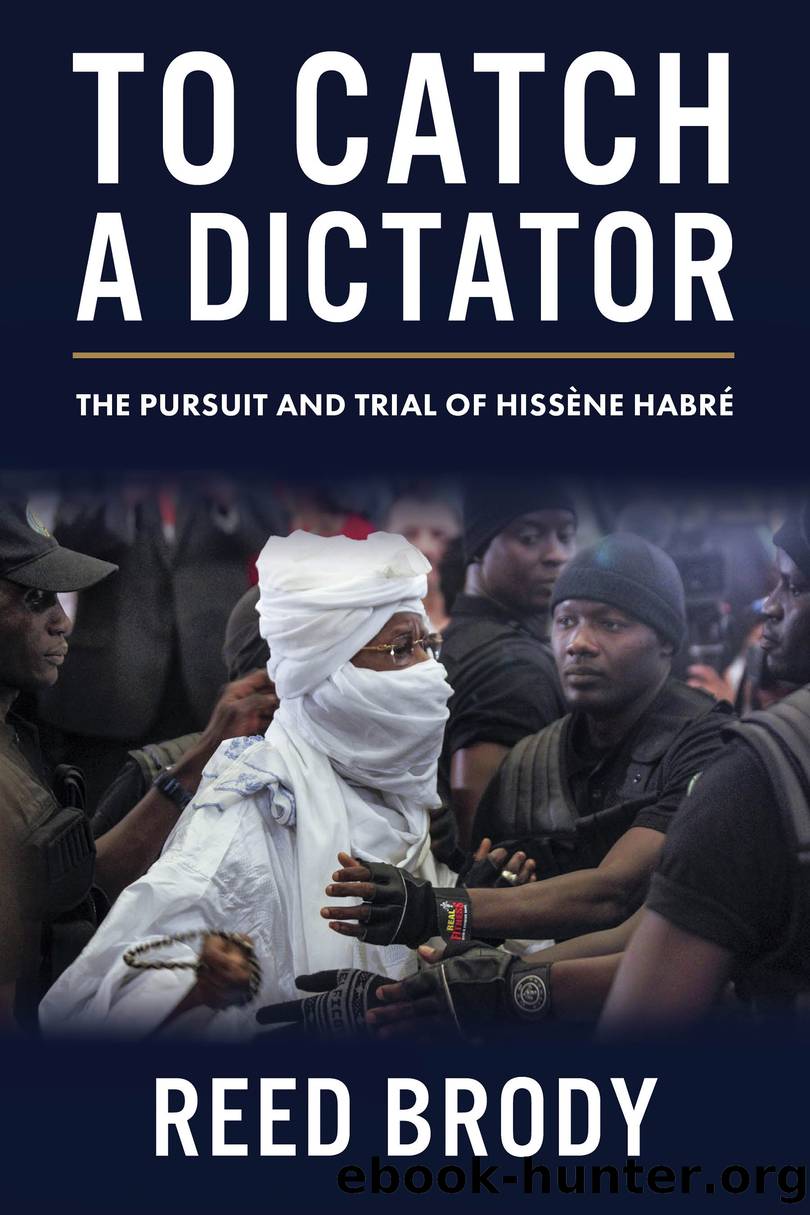
Author:Reed Brody
Language: eng
Format: epub
Publisher: Columbia University Press
* * *
* * *
Six weeks later, we were in the Great Hall of Justice where the ICJ sits, surrounded by elaborate gardens in The Hagueâs ornate Peace Palace. Everything about the court oozed tradition and diplomatic protocol. Court President Hisashi Owada, a Japanese aristocrat whose daughter was married to the crown prince of Japan, conducted the proceedings in French, flanked by the other fourteen judges, all male, seated grandly below the courtroomâs enormous stained-glass windows.
Senegal argued that the case was moot because its government was not disputing the obligation to prosecute Habré. It just needed time to raise the money. There was also no reason to issue an order to keep Habré within its borders because he did not have a passport and the Senegalese government had no intention of letting him go. His house was guarded night and day by an elite unit of the national gendarmerie, and he had no means of escape.
I wished I could put more credence in the expressions of good faith that the five Senegalese lawyers made throughout their representations to the court. I knew from hard experience, though, that such statements from the Senegalese government were rarely sincere. I wished, too, that we could offer our own arguments to the judges. But we were not parties to the case and could only listen in silence.
I thought Belgiumâs case was strong on the merits, but to argue successfully for a preliminary injunction it had to demonstrate not only that Senegal was obliged to prosecute or extradite Habré but that Belgium also had legal rights of its own that an injunction would be able to protect.
I worried that the leader of Belgiumâs legal team, Professor Eric David, was not making the right arguments to establish the second part of this requirement. Eric had been the intellectual inspiration behind Belgiumâs universal jurisdiction law, and he also happened to be a friend of mineânot to mention the landlord of my house in Brussels. He was an idealist who sought to expand the reach of human rights law in any way he could, and I admired him for that. But courtroom strategy was not necessarily his strong suit; heâd been on the losing side at the ICJ when Belgium was defeated by the Congo.
Ericâs argument before the justices began and ended with the dubious assertion that every country had a duty, not only under the torture convention but under customary international law, to extradite or prosecute the perpetrators of torture and crimes against humanity. He didnât even address the question of what Belgium stood to lose without the injunction. Ericâs co-counsel, Sir Michael Woods, a former legal advisor to the British Foreign Office, sought to row back a little from this sweeping declaration by characterizing Belgiumâs request as ânarrow and practical.â But it was obvious from the judgesâ body language that they were uncomfortable with what they were hearing.
Fortunately, one of the judges, Christopher Greenwood of Britain, threw Belgium a lifeline. He asked of both sides: âFirst, does Senegal give a solemn assurance to the Court that it will not allow Mr.
Download
This site does not store any files on its server. We only index and link to content provided by other sites. Please contact the content providers to delete copyright contents if any and email us, we'll remove relevant links or contents immediately.
| Anthropology | Archaeology |
| Philosophy | Politics & Government |
| Social Sciences | Sociology |
| Women's Studies |
The Secret History by Donna Tartt(19103)
The Social Justice Warrior Handbook by Lisa De Pasquale(12197)
Thirteen Reasons Why by Jay Asher(8919)
This Is How You Lose Her by Junot Diaz(6894)
Weapons of Math Destruction by Cathy O'Neil(6285)
Zero to One by Peter Thiel(5808)
Beartown by Fredrik Backman(5768)
The Myth of the Strong Leader by Archie Brown(5513)
The Fire Next Time by James Baldwin(5454)
How Democracies Die by Steven Levitsky & Daniel Ziblatt(5225)
Promise Me, Dad by Joe Biden(5157)
Stone's Rules by Roger Stone(5091)
A Higher Loyalty: Truth, Lies, and Leadership by James Comey(4967)
100 Deadly Skills by Clint Emerson(4932)
Rise and Kill First by Ronen Bergman(4797)
Secrecy World by Jake Bernstein(4756)
The David Icke Guide to the Global Conspiracy (and how to end it) by David Icke(4724)
The Farm by Tom Rob Smith(4517)
The Doomsday Machine by Daniel Ellsberg(4493)
